


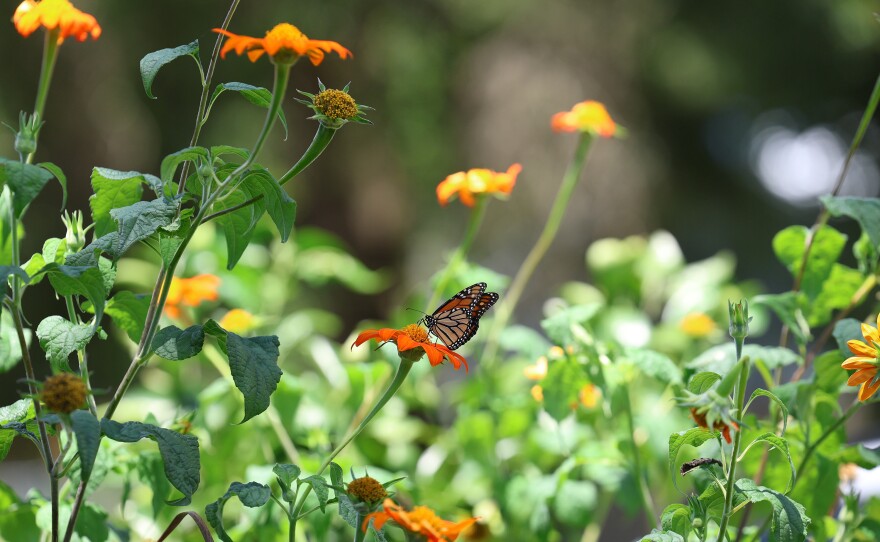


If you grew up in North Central Florida, you might remember seeing more monarch butterflies compared to now. Their bold orange wings outlined with black and white spots were a familiar sight during the warmer months.
Habitat loss, pesticides and disease have made those encounters increasingly rare. Local entomologists and residents are taking action to help bring them back to our gardens.
Why do monarchs matter?
Monarch butterflies are seen as an iconic species because of their migration patterns and their noticeable wings. They are a poster species for all pollinators.
North Central Florida houses two types of monarchs.
“It's kind of this weird place, we have migratory individuals that come through that migrate and breed, and then we have a true non-migratory population,” said Jaret Daniels, a curator for the Florida Museum of Natural History McGuire Center for Lepidoptera & Biodiversity.
The migratory Eastern Monarch migrates to Mexico in the fall and stops in Florida as their first breeding ground before heading north in the spring. The non-migratory Florida Monarch stays in Florida year-round, sometimes moving southward during the winter months but returning north once it warms up.
Monarchs play a vital role in our ecosystem as pollinators. When they stop on a flower to sip nectar, pollen settles on them and they carry it to other plants which fertilizes flowers and enables plant reproduction.
Their ability to do this depends on the presence of the one plant they need to survive: milkweed.
Milkweed is the only plant monarchs can use to lay their eggs and is the sole food source for caterpillars. As the plant disappears from our landscapes, so do the resources monarchs need to reproduce and survive.
With Alachua County having the largest population of entomologists per capita in the U.S., they have been able to take a close look at the population decline in the area.
What is causing the population to decrease?
The Florida Museum of Natural History published a research news article in 2018 stating they did a 37-year survey of the monarch populations. In this survey they found that in North Central Florida the population of monarch caterpillars and butterflies had dropped by 80% since 2005.
“No matter how you look at it, the North American population of monarchs is declining, and has been declining for some years,” Daniels said.
The biggest known factors that have contributed to the monarch’s decline are development, the overuse of pesticides and Ophryocystis elektroscirrha, commonly referred to as OE.
Development
Florida has had several cities on the fastest growing U.S. metro cities lists for years. This fast growth rate has led to an increase in development of land used for residential and commercial purposes.
Native Florida milkweed can flourish on unkept land, roadsides and pastures. With land use change, milkweed is cut out and natural habitats are destroyed for monarchs.
“I mean, if you take a ride through all of these developments, there's not a single flower in any of these landscapes,” said John Calta, a hobby gardener. “It's all shrubs, bushes, trees. That's a desert for pollinators.”
Pesticides
Milkweed is a pollinator plant commonly used in home landscapes. However, the commonality of pesticide spraying can harm pollinator populations. Pesticides encapsulates insecticides, herbicides and fungicides.
“Most people don't like bugs,” said Vaughn Shirey, assistant curator of butterflies and moths at the Florida Museum of Natural History. “One of the biggest contributors to this larger pattern of global insect decline is just like the overuse of pesticides in our environment.”
When there are pesticides or chemicals used on plants, they find their way into the tissue of the plant and can infect it for weeks. If a female monarch lays an egg on an affected plant, the caterpillar will eat the plant and die.
Ophryocystis elektroscirrha
Another danger through plants is OE. This is a naturally occurring parasite that sits on top of plants and can infect monarchs by causing wing deformities, prevent the butterfly from emerging from its chrysalis and physical weakness. When a monarch comes in contact with the parasite spores that sit on top of milkweed they can spread it to other plants.
“A sick person touches a door handle and then you get sick because you touched it,” said Shirey.
“It’s the same idea. Infections can cause crumpled wings and can be consumed by newly hatched caterpillars.
Migratory monarchs have a chance to clear the infection during migration. However, this is not the case for the Florida resident populations. Without migrating, they don’t have a chance to clear the infection. Monarchs with the parasite have decreased flight endurance and often die off before reaching the migration destination.
Community Conservation Efforts
The Florida Museum of Natural History held its fourth annual Pollinator Palooza the last week of June. The event at First Magnitude Brewing Company had tabling organizations, live music, specialty beer releases and a native plant giveaway.
The event's focus was to show attendees the importance of pollinators and that you don’t have to be a professional to protect and care for them.
Asheleigh Garuz, who has a home garden with flowers, native plants, fruits and vegetables attended the event.
“We got starry rosin weed, and the seaside oxeye,” Garuz said.
One of the easiest ways to do that is to plant native milkweed. Daniels says out of the 21 species of milkweed in Florida, pink swamp milkweed, butterfly weed or aquatic milkweed are the most accessible and easy to grow.
Tropical milkweed is one of the most commonly sold milkweeds. However, this plant is considered invasive and is sold as ornamental. Monarchs do love the plant, but it doesn’t die in the winter like other native milkweeds. This disrupts migration and escalates winter breeding.
“That plant is sort of setting monarchs up as, like, an ecological sink,” Daniels said.“ It's drawing them in, to use that plant, and that can have negative consequences on the butterfly.”
Calta has tropical milkweed in his home garden. To avoid disrupting the monarch's pattern, he keeps his milkweed in vases and in the winter brings it inside to trim it down to the stems.
This also helps clear any OE or lingering pesticides on the plants.
“We used to have enclosures where you put the caterpillar in to protect it,” said Stacey Calta. “I haven't seen any OE in a monarch since we stopped with the enclosures.”
They don’t use any pesticides on their plants either. John Calta stated that he stopped using them after seeing people talk about the decline of pollinators through Youtube.
“We're gonna let ecosystems work. We're gonna let Mother Nature take this course,” he said.
While most pesticides aim to target mosquitoes, it can get picked up by the wind and land on native plants.
After starting with one plant, the Calta’s property is now covered with native plants.
“We got our first milkweed planted, and, oh, look, we got a caterpillar. Then that's when it all started,” said John Calta. “ It just takes one caterpillar and you're hooked.”