

More than 4,000 travelers motor through the tiny Panhandle town of Esto (pop. 375) each day, zipping past a meat processor, a Baptist church, and a three-employee town hall minutes from the Alabama state line.
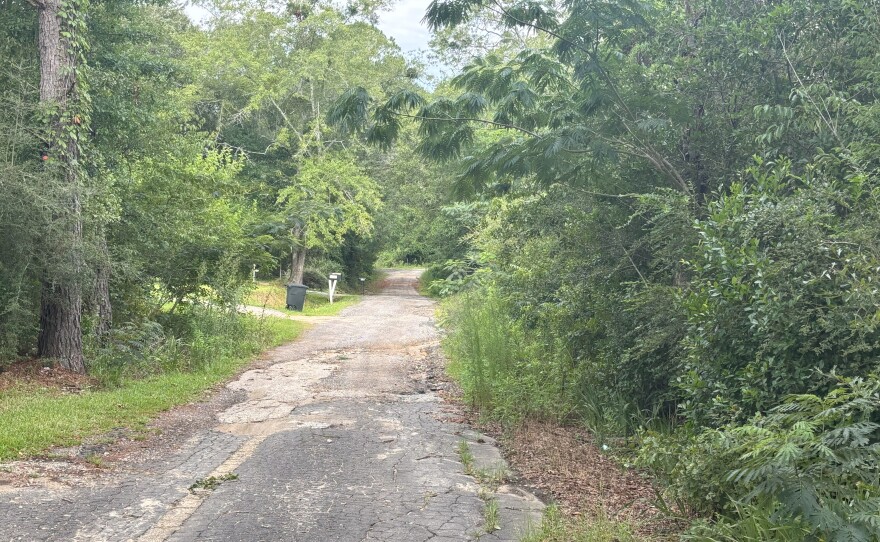
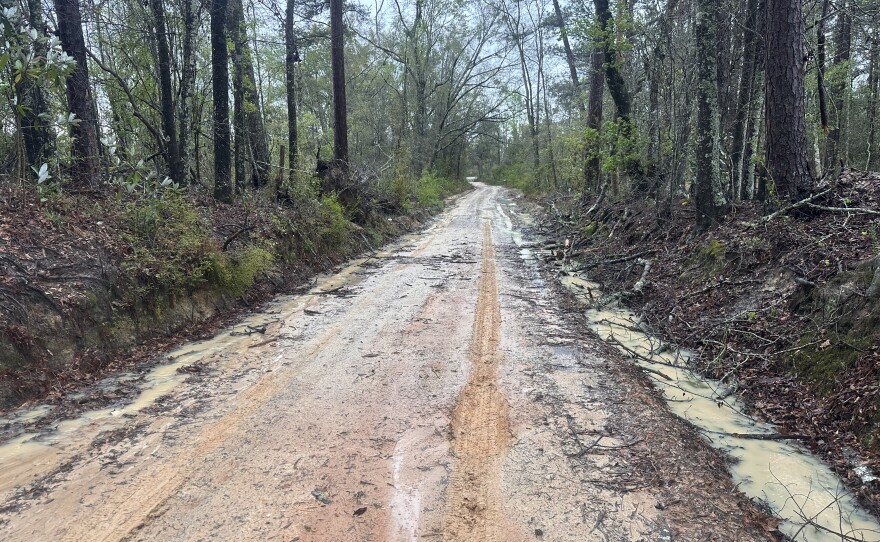
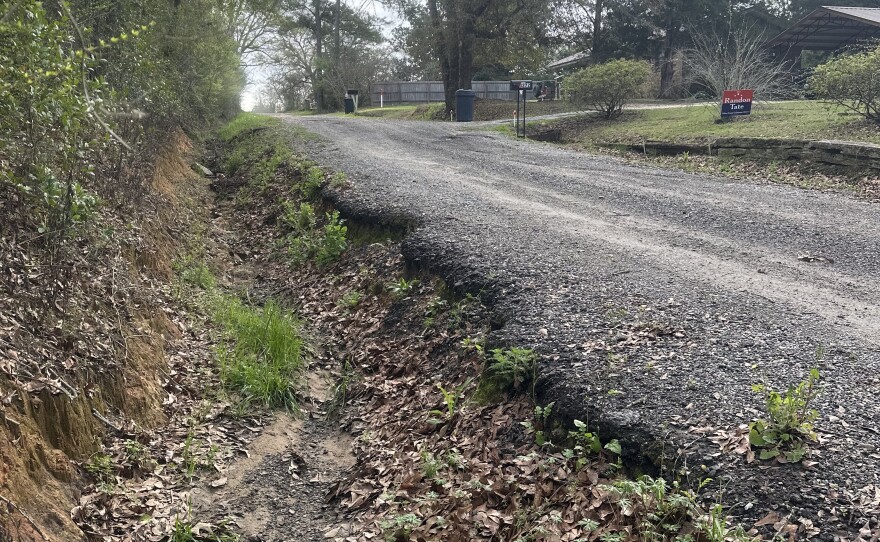
Its streets bear signs of years-long structural fatigue. The town’s patchwork of ditches and culverts can’t keep up with repeated heavy rains and flooding, which erode the roadside and pile up sediment. So, Esto’s engineering contractor recommended town staff apply to Resilient Florida, a state grant program that offers to help local governments prepare for growing flood risks by paying for them to study, then fix, their vulnerabilities.
Esto received $235,000 from the state in 2024 to draft a stormwater plan and, in its assessment, discovered something startling.
If erosion continues along First Avenue, one of the town’s main residential roads, there’s “a high risk that portions of the roadway could collapse,” engineers said. The next logical step was to apply for $3.2 million more in state funding to fix it in 2025.
But without providing any feedback to the town’s leadership, Resilient Florida staff turned away Esto’s proposal. State records obtained by WUFT show evaluators deemed the project “ineligible” because the local roadways it would fix are not considered “critical assets” under state law.
Town Clerk Ben Tew was disappointed when he got the news.
“ We've done all this planning work,” Tew said, “but if there is no implementation money, then what was the use?”
Since its inception, Resilient Florida has funded 347 infrastructure projects in coastal counties and just 30 in inland ones.
Coastal communities have received more than $1.6 billion toward project costs, nearly 20 times what inland counties have. Ninety-two percent of shovel-ready projects funded since the program’s launch are concentrated in coastal counties. More than half (52%) are in Miami-Dade, Broward and Palm Beach counties alone.
WUFT analyzed more than 1,200 applications submitted to the program over the past four application cycles and found coastal applicants have a higher award rate than their inland counterparts.
The discrepancies have left inland communities struggling to get their fair share of a fund created to serve all of Florida against flooding exacerbated by rising sea levels and stronger storms.
“ While Resilient Florida is necessary, it's not sufficient,” said Yoca Arditi-Rocha, CEO of The CLEO Institute, a nonpartisan, climate-focused nonprofit. Local governments are bringing forward projects to protect critical assets like main roads, hospitals and water treatment facilities. “The state is not keeping pace with the demand,” Arditi-Rocha said.
Sea level rise has made climate change tangible along Florida’s coasts for decades. Inland flood risks are rising, too, said Kerry Cook, a professor researching climate change at the University of Texas at Austin.
“ We are seeing increases in inland flooding in association with intensification of storms,” Cook said. “Storms are getting stronger, and they deliver more water per minute, for example.”
Aging infrastructure in rural, inland towns isn’t prepared to deal with the deluge, but tiny tax bases can’t fund the upgrades. That makes grant funding especially important for towns like Esto – and rejections especially disappointing.
“ I know Florida's big on the coast, and maybe that's what the main focus of this sort of resilient grant program is, but we are still Floridians here inland,” Tew said.
Flooding a top priority
Linda Shi, associate professor at Cornell University's Department of City and Regional Planning, lives more than 800 miles from Florida, but focuses much of her research there because it’s “the ground zero of climate change impacts,” she said.
The state’s low-lying geography, long coastline and reliance on its coasts as moneymakers make it especially vulnerable to sea level rise, Shi and collaborators reported in a peer-reviewed 2023 paper.
With the 6.6 feet of sea level rise climate scientists project by 2100, she found more than half of Florida’s municipalities will lose revenue related to property taxes.
Yet “those with extreme levels of fiscal risk from sea level rise were not any more likely to be doing adaptation planning compared to those with much lower levels of fiscal risk,” Shi said.
When Shi surveyed the municipalities to ask why, the overwhelming answer was funding.
Legislators created Resilient Florida to provide that funding.
When Gov. Ron DeSantis signed the bill creating the program in 2021, his office called it “part of the largest investment in the state’s history – over $640 million – to support efforts to ensure state and local communities are prepared to deal with the impacts of sea level rise, intensified storms and flooding.”

The legislation also created the Florida Flood Hub, a center based at the University of South Florida that convenes workgroups of internationally recognized experts to guide flood research and modeling.
“Obviously the goal would be to put the available resources into protecting the most vulnerable assets,” said Chuck Jacoby, the hub’s strategic program director.
The hub estimates changes in sea level and intensity of rainfall and expects local governments to use those data when assessing flood risks. That ensures their results are standardized and reliable, Jacoby said. Since its inception, Resilient Florida has awarded more than $1.8 billion for “planning” projects to study local vulnerabilities and “implementation” projects to address them.
The latter are much more expensive, accounting for more than 90% of the program’s spending to date. Resilient Florida kicked off with an influx of federal dollars but is now funded by the state. Funds for the program come from gambling revenue and the state documentary stamp tax, typically collected on deeds and mortgages.
As the federal government cuts back on its climate spending, “a lot of other states are now looking to see who is well-positioned to kind of tackle resilience themselves,” said Rachel Rhode, a manager of flood resilience with the Environmental Defense Fund, a nonprofit focused on climate solutions, energy, ecosystems and human health. She pointed to Florida and Virginia as examples of strong investors in resilience.
But while Virginia historically paid for some of its upgrades with greenhouse gas fees from the power sector, Florida’s program doesn’t mention climate change.
It addresses symptoms of climate change, like flooding, without moving to reduce the human-generated greenhouse gas emissions that cause it.
“We keep mopping the floor of this overflowing bathtub,” Arditi-Rocha said, “and we're cleaning it with taxpayers' dollars.”
She’d like to see state legislators turn off the tap.
Arditi-Rocha said a “winning strategy” would target causes and effects of climate change with equal intensity. “Right now we're not doing that,” she said.
Orange County Rep. Anna Eskamani, who has served four terms in the Florida House and is running for Orlando mayor, called the program reactive rather than proactive.
“The state Legislature has, in so many ways, just turned a blind eye to climate change,” Eskamani said. “What ends up happening is that the focus of the program and the projects that are funded are more mitigating harm versus trying to prevent harm.”
Eskamani noted the program’s sparse inland awards are another shortcoming. Floodwaters from Lake Eola in downtown Orlando took days to dissipate after Hurricane Ian, she said, and street flooding is common during the rainy season.
Flood resilience, Eskamani said, “definitely needs to be a shared focus for all of our communities since we’re all directly impacted.”
Florida’s Chief Resilience Officer, Eddy Bouza, did not respond to questions on the program’s geographic priorities nor agreed to our request for an interview to answer questions about the program.

A coastal disparity
Resilient Florida replaced a similarly named but coastal-only predecessor, the Florida Resilient Coastlines Program. The change opened up millions of dollars in state funding to inland communities that hadn’t previously been eligible, yet WUFT’s analysis of all applications submitted to the program indicates they may still be missing out on their share.
Resilient Florida awarded 347 implementation grants to communities in coastal counties and 30 to those in inland counties between the program’s launch in 2021 and last award announcement in July 2026.
That’s not just because inland communities apply less, though they do. WUFT’s analysis revealed, over the past four application cycles, inland communities have lower success rates in getting shovel-ready projects approved than their coastal counterparts.
During that time, Resilient Florida funded about 27% of the coastal infrastructure projects submitted compared to about 16% of inland ones.
WUFT reached out to the Florida Department of Environmental Protection, which administers the program, 10 times between May and July 2026 to respond to WUFT’s questions on the apparent discrepancy. Resilient Florida staff provided a spreadsheet of applications submitted to the program and, at our request, evaluator comments on five specific applications named in this story.
Communications staff acknowledged receipt of a summary of WUFT’s findings but didn’t answer questions on the record or make staff available for an interview.
The funded projects fill critical needs in coastal counties, which house about three-quarters of the state’s population, according to the National Oceanic and Atmospheric Administration.
In Daytona Beach, $15 million from Resilient Florida helped relocate the city’s main fire station and emergency operations center after repeated flooding made it unusable during major storms in 2022. Broward County received $32.5 million from the program in 2023 to build a higher seawall in Port Everglades, a significant hub for both cargo and cruise ships, to prepare for continued sea level rise. The South Florida Water Management District has been awarded more than $100 million in Resilient Florida funds to tackle flooding and saltwater intrusion in and around Miami-Dade County.
But the inland projects that missed out have high stakes, too.
The City of Longwood in Seminole County, about 15 miles north of downtown Orlando, applied for $3 million in 2022 to relocate its fire station because flooding “threatened to disrupt emergency response for the entire community,” of more than 15,500 residents. The program didn’t fund the relocation that year and found it ineligible the following year when Longwood reapplied because of “insufficient documentation to identify flood risk,” documents obtained by WUFT show.
Evaluators’ scores and notes are public records, meaning anyone can request them. Tew, in Esto, didn’t know he could ask. It’s unclear how many applicants do, as FDEP staff didn’t share how many requests they’ve received, and if, or how they make the option known.
Thirty-five miles west of Longwood, a $4.8 million request from the City of Mascotte in Lake County to relocate its water treatment plant and public works building qualified in 2024, but didn’t rank highly enough to win the cash.
Two months after Mascotte learned it didn’t make the cut, Hurricane Milton caused “severe flooding” onsite, just as engineers had warned. The city applied for help again in 2025, noting, “the event triggered high wet well alarms and caused operational disruptions across Mascotte’s infrastructure.” It ranked 96th of 123 eligible projects this cycle, lower than the last time it applied.
The disparity between inland and coastal grant numbers didn’t come as a surprise to Amanda Boone, a senior project manager with Woodard & Curran, an environmental consulting firm.
Municipalities hire engineering firms like Boone’s to study their flood vulnerabilities through one side of Resilient Florida and manage construction work on the other side. Municipalities typically use grant funds to pay them.
“The program, I think, really originally kicked off with a lot of the coastal communities,” Boone said. “I think that was the primary forward focus and inland communities have kind of come after that.”
In 2015, partially driven by insurance companies’ warnings, Florida’s Peril of Flood Act required coastal communities to account for sea level rise in their comprehensive plans, according to Shi, the researcher at Cornell.
Resilient Florida's rubric scores projects on risk mitigation (40%), project readiness and ecological value (30%), local funding and construction standards (20%) and innovation and community assistance (10%). When it came time to make the case for funding, built-up coastal communities could demonstrate their vulnerabilities through data.
But those same vulnerabilities didn’t deter developers, said Kim Dinkins, policy and planning director for the smart growth nonprofit, 1000 Friends of Florida. “We're seeing this desire to intensify building in areas where we are seeing more impacts of sea level rise and impacts of these stronger and more frequent storms,” Dinkins said.
Buyout programs like those guiding development away from coastlines in New York, Massachusetts, North Carolina and Texas are “completely anathema” in Florida, Shi said. Still, some coastal residents are moving inland on their own.
Alachua County, for example, expects an influx of 23,000 climate migrants from Florida’s coasts in the next 75 years, according to the Bureau of Economic and Business Research at the University of Florida.
That makes inland communities’ flood resilience projects even more crucial, Dinkins said. “Not only are they going to have the impacts of the more frequent and intense storms, but they're going to have more people that they have to deal with.”
Most communities have now completed studies of their flood risk, according to the 2025-2026 Resilient Florida annual plan.
As of 2024, FDEP required those studies for communities to qualify for future funding, said Diane Quigley, a senior project manager with the engineering firm Stantec. She was director of the Resilient Florida program during its first year.
Now that inland applicants have the data their coastal counterparts began tracking more than a decade ago, does Quigley expect inland applicants to start getting more grants to make the upgrades they need?
“I hope so,” she said. “I hope they understand that they're just as eligible.”

Lacking capacity
Project managers and the Resilient Florida program itself largely adopt a knowledge-is-power stance, saying that mapping a community’s flood risk positions it to reduce its vulnerability.
Nearly 95% of the state’s counties and municipalities will complete vulnerability assessments by 2026, according to the program’s 2025-2026 annual plan. While assessments vary for different hazards and places, the United Nations Office for Disaster Risk Reduction and other environmental groups endorse them as science-backed assessments of what’s most at risk.
But some inland stakeholders say their communities are chronically under-resourced. Having the data to understand their risk, they say, does little good without a way to do anything about it.
“ I've seen a lot of inland communities apply for the implementation funding through Resilient Florida after they've done a vulnerability assessment, but, while they're good projects, they just haven't been able to compete with some of the bigger projects and with some of the coastal communities,” said Morgan French, a director with the same engineering firm as Boone.

Shannon McNeeley researches planning and action on water and climate with a focus on frontline communities at the Pacific Institute, a California-based nonprofit.
“You’ve got to have the capacity to apply to get the funding first and then you have to have the capacity to implement it,” McNeeley said.
She explained that those capacity constraints are a big reason why inland communities, especially rural ones, may not be able to compete with larger, coastal communities in some grant programs.
What’s that word?
Staff at Resilient Florida divide grant applications into two categories:
Ineligible: These projects don’t meet the program’s minimum criteria and don’t move forward.
Eligible: These projects qualify for funding. Program staff rank them based on their total score in an annual list submitted to the Florida Legislature.
The Legislature funds some of the highest-ranked projects based on its budget.
Not funded: These projects don’t get funds and must apply again next cycle.
Funded: These are the year’s winners. They are the only ones that get grant money.
Back in Esto, Ben Tew laughed at the thought of having a staff member solely devoted to grant applications and management. “Being our size, there's just me as a town clerk,” he said.
That’s common throughout the Panhandle, said Roy Baker, leader of a regional economic development organization called Opportunity Florida.
“With a lot of our counties being small in nature, being rural, you don't have a lot of county staff,” he said. “People wear multiple hats when they work for the county.”
Money, too, is scarce in Baker’s 12-county region.
While the area’s coastal counties got an economic boost from the multibillion-dollar settlement of BP’s Deepwater Horizon oil spill, inland ones didn’t. All are fiscally constrained, according to the Florida Department of Revenue.
Small tax bases can’t fund the big upgrades old power grids and wastewater systems need, Baker said. “A $5 million grant is nothing when you send it to Miami,” he said, “but a $5 million grant to a rural county is a big deal.”
Low-income communities have to be especially judicious with their dollars, said Rep. Chad Johnson, whose district includes fiscally constrained counties Levy, Gilchrist and Lafayette and part of Alachua County.
In terms of funding priorities, “flooding probably doesn't make it even into the top five unless, of course, it’s right after a tropical storm or a hurricane,” he said.
One project in Johnson’s district, a lift station in Newberry, got funding this application cycle.
It’s the first infrastructure project in an inland county to get a Resilient Florida grant in two years out of 56 that applied.
Coasts and costs
In northwest Gainesville, far from any coasts or rivers, Pamela O’Steen’s house has flooded five times since she moved there 26 years ago.
“My family calls me when there's a storm going on,” she said. “They're like, ‘Oh, did you make it through the night?’”


Her lot sits next to the neighborhood’s only entrance and exit. During storms in 2004 and 2017, county documents report, “access to and from 144 homes and condominiums was blocked, impacting approximately 390 residents.”
Alachua County has applied to Resilient Florida three times on O’Steen’s behalf with requests ranging from $315,000 to $626,000. That money would buy out the property, demolish the house and turn the lot into a stormwater basin.
The project qualified the first time but wasn’t funded. FDEP staff deemed it “ineligible” the second time because of “insufficient documentation to identify flood risk,” state records show. The county’s third application included 10 photos of floodwaters on O’Steen’s property and FEMA proof of loss forms, but was again classified as “ineligible.” That time, staff comments said none of the infrastructure around O’Steen’s lot qualified as a “critical asset.”
O'Steen’s buyout is one of the cheaper projects submitted to Resilient Florida. Many cost millions of dollars.
There’s not enough money to go around, said Rhode of the Environmental Defense Fund.
“We’re seeing them barely scratch the surface,” Rhode said about the average number of projects funded each year. “Six out of seven communities that apply don’t get any funding whatsoever just because of the sheer demand.”

Florida law requires FDEP to propose at least $100 million worth of resilience projects to the Legislature each year, but lawmakers can fund more or less than that at their discretion.
The Environmental Defense Fund and American Flood Coalition hope to see the program consistently funded above $100 million. The Florida Council of 100, formed by state business leaders, wants more. It recommended raising the program’s annual budget to $500 million in a January report, stating “inaction carries a steep price — declines in GDP, business closures, housing instability, and long-term erosion of community viability.”
But lawmakers are doing the opposite. Though the governor’s “Department of Government Efficiency” cuts haven’t targeted Resilient Florida as they have other climate efforts in Palm Beach County and St. Petersburg, its budget is shrinking.
Last year, legislators allocated a record low of $172 million to Resilient Florida, according to numbers provided by FDEP, which funded 15% of qualifying construction projects. This year’s budget allocates $160 million, $10 million less than the Legislature requested because of a veto by the governor.
“The state not keeping pace with the demand puts a lot of our communities at risk,” said Arditi-Rocha, the CLEO Institute CEO.
Senator Kristen Arrington, whose district includes Osceola County and part of Orange County, expects climate change to continue to drive up flood resilience needs.
“This growing demand risks leaving inland communities with fewer opportunities to secure funding for resilience projects, despite facing their own flood and infrastructure challenges,” she wrote in a statement to WUFT.
A shrinking pool of grant money means steeper competition, said Boone of Woodard & Curran.
That may be another barrier for smaller communities.
While planning grants come fully funded, infrastructure grants require communities to pay at least half of the project’s cost unless their size and per-capita income qualify them for low or no cost share. “ Some of the smaller communities may not be able to afford the match,” said Quigley, the former program director.
Program watchdogs spotted that problem a few years ago.
In 2024, the American Flood Coalition found that some communities too large to qualify as financially disadvantaged faced economic barriers, too. Lawmakers unanimously voted to update program criteria that year, allowing 26 new communities to qualify for reduced cost shares. Gainesville, Lake City and Putnam County were among the places newly eligible for extra financial help.
The change made little difference for O’Steen, whose flood-prone property sits in unincorporated Alachua County despite its Gainesville address. Though Gainesville qualifies for lower costs, Alachua County doesn’t.
“We can’t, obviously, let every city not pay,” said Kate Wesner, Florida Director for the American Flood Coalition. “There’s limited funds in every case, so how do we make the best use of that?”
Continuing to apply

Midway between Tallahassee and Jacksonville sits the 7,000-person City of Live Oak. Once the largest inland city in Florida, it’s now an agricultural and manufacturing area where about 16% of the population lives below the poverty line, according to census data.
The city experienced historic flooding from Hurricane Dora in 1964. Then-Gov. Farris Bryant boated through the city’s submerged streets in the aftermath but did little to reduce its flood risk.
Live Oak flooded again from storms in 2012 and 2024, submerging wastewater lift stations and seeping into homes and stores despite 45 or so drainage wells – or “go away holes,” as folks in town call them – designed to funnel stormwater underground.
“ The people downtown have no insurance anymore,” said Live Oak City Manager Larry Sessions, one of DeSantis’ appointees to the Suwannee Water Management District Governing Board. “They can’t get insurance because they’ve been flooded three times.”
Following a $300,000 planning grant approved from Resilient Florida last year, Sessions and a team of engineers designed a system of piping, pumps and ponds to mitigate flooding.

Like other inland communities, Live Oak City officials were optimistic about their odds for funding despite a shrinking program budget. This cycle, Live Oak applied for a $56.5 million grant, among the most expensive single projects ever submitted.
Driving around town in a pickup truck, Sessions gestured excitedly to pieces of his plan. “I’m going to dig up that street behind us,” he said, passing a mural still bearing a waterline from Hurricane Debby. A stormwater pipe would go in behind Hardee’s. A city park would house two new, five-acre ponds.
The improvements relied on Live Oak getting the grant, something Sessions felt “99% sure” would happen because of the severity of the city’s flooding.
The project qualified, but when FDEP officials announced this year’s 23 winning projects in July, Live Oak wasn’t on the list.
It wasn’t anywhere close, ranking 119th of 123.
This investigation was produced with the support of Report for America and Investigative Editing Corps with Mc Nelly Torres as the project editor.

How we reported this story
The reporter interviewed 28 sources including program applicants, affected residents, local and state government officials, environmental experts, nonprofit leaders and planning consultants over six months and visited Live Oak, Greenville and Alachua County to observe flood impacts firsthand.
Our methodology: The Florida Department of Environmental Protection provided a SalesForce database of 1,883 applications to the Resilient Florida program, spanning application years 2022-2025. We cleaned the database to remove 630 withdrawn, expired or draft applications.
Coastal and inland comparisons: We classified municipalities as coastal if they were within a coastal shoreline county according to the National Oceanic and Atmospheric Administration. Submissions from multi-county coalitions and water management districts were omitted, as they represented a mix of coastal and inland communities.
“Implementation” award numbers: Awards were tallied from the FDEP’s ArcGIS dashboard and fiscal year 2026 -2027 awards and were current through July 15, 2026.
Award rate calculations: Award rates were calculated by dividing the number of funded projects by the number of total projects submitted. “Ineligible” projects were included in the project total to account for the possibility that selection criteria or applicant resources could influence eligibility. Rates are for application years 2022 through 2025, as applications from 2021 utilized a different software.
External review: A consultant from the Indiana Statistical Consulting Center reviewed WUFT’s award rate calculations and validated its results.
