
-
 Court Mast/AP/APThis is an opportunity to highlight that sexual abuse has always involved grooming. Our recognition and understanding of this is more recently developed and that explains why people haven’t disclosed historically.
 -
 Frog Song Organics in Hawthorne will pilot a new “food hub” model to get more local produce into schools, prisons and community centers, Alachua County announced this week.


-
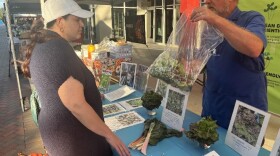 Alachua Greens grows and delivers leafy produce to local establishments as far as St. Augustine. Though he owns the business with his wife, Lisa Sanders, a doctor at the University of Florida, the farm is, for the most part, a one-man operation. Patrick Gruninger does everything from planting the peat moss plugs to cleaning out the algae.
 -
 Our editors' selections for the biggest news stories covered by WUFT in 2025.
 -
 Food insecurity in Alachua County is higher than the 14.4 % average across the Sunshine State, and it's an area of focus for one local entrepreneur.
 -
 For farm owners in Florida, learning about new ways to build profit for their farm is a necessity amid the ongoing loss of agricultural land.
 -
 Unlike surface waters, which swell hours or weeks after a good storm, aquifer levels depend on about two years’ worth of rain. One wet weekend can’t fully restore the Floridan Aquifer’s flow, especially as an ever-growing number of wells competes for its water.
 -
Long before a Thanksgiving turkey reaches your table, farmers are hard at work feeding the birds, monitoring their health and guiding them from hatch to harvest.
-
 Several North Central Florida developements are emulating the food-centric layouts of the earliest agricultural communities in Mesopotamia, China and South America. Agrihoods share the “back to the land” goal of the intentional communities and ecovillages that gained popularity in the 1960s and ‘70s, but cater to a 9-to-5 crowd.
 -
 The effort, led by horticultural scientist Zhanao Deng, aims to tackle common issues faced by growers.
 -
 A crowd of over 300 people gathered on Friday for the annual Florida Museum of Natural History’s spring plant sale. Before the gates opened at 10 a.m. a line was already forming around the corner of Hull Road.
 -
 The Federal Crop Insurance Program costs the government an average of $9 billion annually. Climate change could raise its price tag by up to a third by 2080.


